Toenail Fungus Incubation Period Explained
Find a Podiatrist Near You
Get same-day appointments with verified podiatrists. Insurance accepted.
The toenail fungus incubation period is one of the most clinically misunderstood aspects of onychomycosis — and one of the main reasons patients seek treatment months or even years after an infection has already become well established. Fungal nail infections do not announce themselves immediately after exposure. They develop silently, beneath the nail surface, during a period when nothing visible is happening yet everything biologically relevant already is.
Understanding the toenail fungus incubation period helps patients recognize why symptoms appear long after the suspected exposure point, why some infections seem to appear from nowhere, and why the window between exposure and visible nail changes is not a window of safety — it is a window of silent infection development.
This guide explains the full biological timeline of toenail fungus from initial spore contact through visible infection, what factors shorten or lengthen the incubation phase, whether the infection is contagious during this period, and why earlier intervention produces meaningfully better outcomes.

What the Toenail Fungus Incubation Period Actually Means
In medical terminology, the incubation period of any infection refers to the time between initial exposure to the causative organism and the first appearance of recognizable signs or symptoms. For most infections, this period involves active biological activity — the organism is replicating, establishing itself in tissue, and producing changes — but the scale is not yet sufficient to produce visible or symptomatic signs.
The toenail fungus incubation period follows this same principle, but with characteristics that make it distinctly prolonged compared to most other infections.
Why the toenail fungus incubation period is unusually long:
Dermatophyte fungi — the organisms responsible for roughly 80 to 90 percent of toenail infections — are slow-growing organisms. They do not reproduce rapidly like bacteria. Their growth cycle is measured in days per generation rather than hours.
The nail plate itself adds another layer of delay. Fungal organisms establishing beneath the nail must penetrate a dense keratin structure that grows at approximately 1.5 mm per month. Structural changes caused by the growing fungal colony beneath the nail do not become visible at the nail surface until the infection has expanded sufficiently to alter the nail architecture — a process that takes considerably longer than the initial colonization period.
The result is an incubation period that can span weeks to several months between actual spore contact and the first patient-noticeable nail changes.
The 5 Stages of Toenail Fungus Development
Understanding the toenail fungus incubation period is most useful when placed within the full biological sequence of infection development.
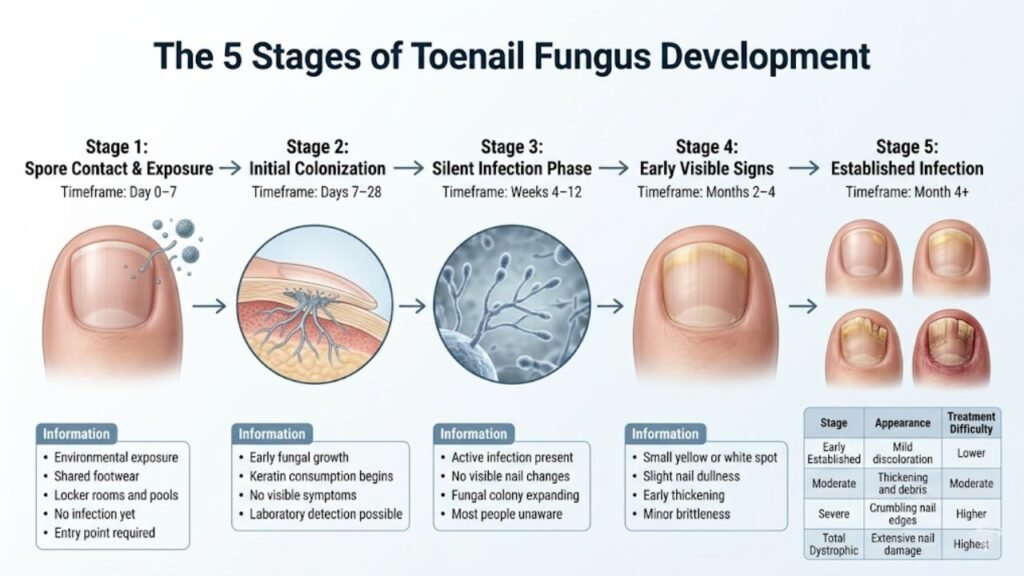
Stage 1: Spore Contact and Exposure
Timeframe: Day 0 to days 1 to 7
Fungal spores contact the foot through environmental exposure — most commonly from contaminated surfaces in gyms, pools, locker rooms, and shower areas, from shared footwear, or from transfer from an existing skin fungal infection (tinea pedis).
At this stage, nothing has happened clinically. The spores are present on the skin or nail surface but have not yet penetrated the nail unit. Whether infection establishes itself depends on what happens next — whether the spores find a suitable entry point and whether the local immune environment permits colonization.
Entry points that allow progression:
- Small cracks or separations at the nail tip (hyponychium)
- Minor trauma lifting the nail from the nail bed
- Compromised skin around the nail fold
- Macerated or softened skin from prolonged moisture exposure
Stage 2: Initial Colonization
Timeframe: Days 7 to 28
When spores successfully penetrate the nail unit, the toenail fungus incubation period in its strictest sense begins. Fungal hyphae — the thread-like structures that form the body of the fungal organism — extend into the nail plate and begin consuming keratin.
At this stage:
- Fungal organisms are actively growing and replicating beneath the nail surface
- No visible nail changes are present
- The infection is not yet detectable through casual observation
- Laboratory testing on nail clippings taken from the entry site might detect fungal elements, but clinical signs are absent
The immune system may mount a local response during early colonization. In people with healthy immune function and no nail vulnerabilities, this response can sometimes clear the early colonization before it advances. In people with risk factors — diabetes, immune suppression, poor circulation, prior nail damage — early colonization is more likely to proceed unchecked.
Stage 3: Subclinical Infection (Silent Phase)
Timeframe: Weeks 4 to 12, sometimes longer
This is the heart of the toenail fungus incubation period — the phase during which active infection is present and progressing, but no external signs are visible to the patient.
During this stage:
- Fungal hyphae are spreading through the nail plate and nail bed
- Keratin breakdown is occurring at a microscopic level
- Subungual debris — the crumbly keratin material that accumulates under the nail — may be beginning to form but is not yet visible externally
- The fungal colony is expanding but has not yet produced changes significant enough to alter the nail’s appearance at the surface
This is the stage during which patients who were exposed at a gym, pool, or through shared footwear are unknowingly harboring an active infection. It is also the stage during which the infection is most efficiently treated — if it could be detected.
The practical challenge is that there is nothing to see, nothing that hurts, and no reason for a patient to suspect infection exists. The toenail fungus incubation period’s silent nature is precisely what allows most infections to advance past the easiest stage for treatment.
Stage 4: Early Visible Signs
Timeframe: Months 2 to 4 post-exposure
As the fungal colony expands and the nail plate begins reflecting the structural damage beneath it, the first patient-visible signs of infection emerge. This marks the end of the toenail fungus incubation period in its clinical sense.
- A small white or yellow spot appearing at the nail tip or under the nail edge
- Slight surface dulling on a previously glossy nail
- Minor brittleness or roughness at the nail edge
- The very beginning of nail thickening at the affected area
- A faint discoloration that does not match remembered trauma or nail polish staining
These changes are subtle and easy to rationalize. Many patients see early discoloration and attribute it to a bruise, to nail polish, or to normal aging. This rationalization extends the period before treatment begins — pushing the infection from its most treatable stage into a more established phase.
Stage 5: Established and Advancing Infection
Timeframe: Months 4 onward without treatment
Beyond the toenail fungus incubation period, the infection progresses into its recognizable clinical form. The nail changes become progressively more obvious and more difficult to address.
| Infection Stage | Nail Changes Present | Treatment Complexity |
|---|---|---|
| Early established | Yellow or white discoloration at tip, mild thickening | Lower — topical therapy often effective |
| Moderate | Thickening advancing, subungual debris, nail lifting beginning | Moderate — oral antifungal usually indicated |
| Severe | Multiple nail involvement, significant thickening, crumbling edges | Higher — combination therapy typical |
| Total dystrophic | Complete nail plate destruction, matrix involvement | Highest — may require nail removal |
How Long Is the Toenail Fungus Incubation Period?
There is no single fixed duration. The toenail fungus incubation period varies between individuals based on multiple interacting factors.
Typical range: Several weeks to approximately 3 to 6 months between exposure and first visible signs.
Factors that shorten the toenail fungus incubation period:
- Pre-existing nail damage — Traumatized nails allow faster spore penetration, reducing the time before infection establishes
- Diabetes — Elevated blood glucose creates favorable fungal growth conditions; impaired immunity reduces clearance of early colonization
- Immune suppression — Without adequate immune surveillance, early fungal colonization progresses to established infection faster
- High spore load exposure — Heavy environmental spore exposure in heavily contaminated environments may accelerate early colonization
- Concurrent athlete’s foot — Active skin infection adjacent to the nail provides continuous, high-density spore contact
- Warm, moist footwear environment — Conditions inside footwear directly support fungal growth rate
Factors that lengthen the toenail fungus incubation period or prevent progression:
- Healthy intact nail with no entry point vulnerability
- Strong immune response that clears early colonization
- Good foot hygiene and dry foot environment
- Regular nail inspection that catches early signs before significant progression
Is Toenail Fungus Contagious During the Incubation Period?
Yes — and this is one of the most practically important facts about the toenail fungus incubation period.
During the silent phase of infection, fungal organisms within the early colonized nail are replicating and producing spores. Those spores shed from the infected nail and surrounding skin even before visible nail changes appear. Contaminated bathroom floors, shared towels, nail tools, and footwear all carry these spores during the incubation period.
This means:
- A person in the toenail fungus incubation period is already a transmission source, even though they have no idea they are infected
- Household members sharing the same bathroom floor, bath mats, and nail tools face real transmission risk from someone in the pre-symptomatic phase
- Environmental hygiene measures cannot wait until symptoms appear — they are needed from the moment exposure is suspected or any risk factor is identified
Why the Toenail Fungus Incubation Period Makes Early Detection Difficult
The fundamental challenge created by the toenail fungus incubation period is the absence of subjective symptoms to prompt action. Unlike bacterial infections that produce pain, swelling, and systemic signs relatively quickly, fungal nail infections offer no such early warning.
Patients typically seek evaluation at one of two points:
- When nail changes become noticeable enough to concern them — by which point the infection is already established and the incubation period long past
- When a healthcare provider notices the changes during an examination for an unrelated concern
Neither scenario represents early-stage detection. Both involve infection that has already progressed past its most efficiently treatable phase.
The most effective approach to catching infection during or shortly after the incubation period is deliberate monthly nail self-inspection. Patients who know their individual toenail fungus risk factors — age, diabetes, athlete’s foot history, gym use — and inspect their nails monthly are most likely to notice early changes while they are still subtle.
What Happens If the Incubation Period Goes Undetected
When the toenail fungus incubation period passes without detection and the infection advances into its established phases, treatment becomes more complex, takes longer, and produces less reliable outcomes.
- Deeper penetration into the nail matrix — the nail growth center — makes complete eradication harder and increases the risk of permanent nail changes even after clearance
- Multi-nail spread becomes more likely as the primary infection sheds spores continuously
- Concurrent athlete’s foot often develops or worsens, creating a continuous reinfection cycle
- In diabetic and immunocompromised patients, delayed treatment increases the risk of secondary bacterial infection and associated complications
The toenail fungus incubation period represents the window of greatest opportunity for straightforward intervention — and the window most patients unknowingly allow to close.
Practical Steps During and After the Incubation Period
Since the toenail fungus incubation period cannot be reliably detected through symptoms, proactive habits are the only practical response.
If you have been exposed to a high-risk environment:
- Wash and completely dry feet immediately after exposure
- Apply antifungal powder to feet and inside footwear for several weeks following any significant communal wet area exposure
- Begin monthly nail inspections and document any baseline nail appearance for comparison
- If you have multiple risk factors, consult a podiatrist for evaluation even in the absence of visible symptoms
If you suspect you may be in the incubation period:
- Maintain strict moisture control — fungal growth rate is directly tied to moisture availability
- Do not share nail tools, footwear, or towels with household members
- Wear protective footwear in shared bathroom areas
- Treat any concurrent athlete’s foot with topical antifungal cream immediately
If early signs appear at the end of the incubation period:
- Do not wait to see if changes resolve on their own — spontaneous clearance of established nail infection is rare
- Seek professional evaluation for laboratory confirmation before starting treatment
- Early-stage infection caught at or shortly after the end of the incubation period may be amenable to topical antifungal therapy alone — a simpler and shorter treatment path than oral medication
Frequently Asked Questions About Toenail Fungus Incubation Period
How long is the toenail fungus incubation period before symptoms appear?
The toenail fungus incubation period typically ranges from several weeks to approximately 3 to 6 months. The wide range reflects individual differences in immune function, nail health, moisture exposure, and the level of spore contact during the initial exposure event.
Can you have toenail fungus without knowing it during the incubation period?
Yes — this is the defining characteristic of the toenail fungus incubation period. The infection is biologically active and progressing beneath the nail while producing no external signs that would alert the patient. Many patients discover they have had an infection for months or years before diagnosis.
Does everyone exposed to fungal spores go through the incubation period and develop infection?
No. Exposure does not automatically produce infection. People with intact nails, healthy immune function, and good foot hygiene may resist colonization even after significant spore exposure. The incubation period only applies when the spores successfully penetrate the nail unit and begin establishing the infection.
Is the toenail fungus incubation period shorter in diabetic patients?
Generally yes. Diabetes impairs the local immune response that might otherwise clear early colonization, and elevated blood glucose creates favorable conditions for fungal growth. Diabetic patients also tend to have more nail damage and circulatory compromise, providing more entry points for faster establishment.
Can treatment be started during the toenail fungus incubation period?
Treatment cannot be initiated during the true incubation period because there is nothing to diagnose — no visible signs and no reliable way to detect early colonization in clinical practice. Treatment begins once the infection produces visible changes that allow diagnosis and laboratory confirmation.
Does catching infection at the end of the incubation period change treatment options?
Significantly. Infections caught at the earliest visible stage — when only minor discoloration is present and less than 50 percent of the nail is involved without matrix penetration — may respond to topical antifungal therapy alone. This is the simplest, safest treatment pathway. Catching infection later typically requires oral antifungal medication and longer treatment courses.
Summary
The toenail fungus incubation period explains one of the most clinically frustrating aspects of nail fungal infection — why patients present for treatment months or years after an exposure they may not even remember, with an infection that has been silently progressing throughout. The five stages of infection development — spore contact, initial colonization, silent subclinical infection, early visible signs, and established advancing infection — illustrate exactly why early detection is so clinically valuable and why the infection is already contagious long before it becomes visible.
The toenail fungus incubation period cannot be shortened or influenced once exposure has occurred. What can be influenced is the speed of detection after visible signs emerge, the quality of preventive hygiene during high-risk exposure periods, and the promptness of professional evaluation when early nail changes appear.
If you have risk factors for fungal nail infection — age, diabetes, athletic activity, communal facility use — monthly nail self-inspection is the most practical tool available for catching infection at or shortly after the incubation period ends, when treatment is simplest and outcomes are best.
Struggling to get an appointment?
We help patients in your area bypass clinic waitlists by instantly finding verified podiatry doctors who accept their insurance.