How Fast Does Toenail Fungus Progress?
Find a Podiatrist Near You
Get same-day appointments with verified podiatrists. Insurance accepted.
Toenail fungus progress is rarely dramatic — and that is exactly what makes it dangerous. The infection does not cause sudden pain or rapid visible change. It advances slowly, week by week, beneath a nail that continues to look mostly normal until it does not. By the time the changes become undeniably obvious, the infection has typically been progressing for months.
Understanding how fast toenail fungus actually progresses — and what specific factors determine whether it moves slowly or accelerates — is one of the most clinically useful things a patient can know. It changes how urgently early signs should be taken, why certain health conditions require extra vigilance, and why treatment started early produces dramatically better results than treatment started after the infection is established.
This guide explains the full toenail fungus progress timeline, the biological reasons it unfolds the way it does, the factors that accelerate or slow it, and what each stage of progression means for treatment.

Why Toenail Fungus Progress Is Gradual by Nature
To understand toenail fungus progress, you need to understand what is actually happening beneath the nail.
Toenail fungal infections are caused primarily by dermatophyte organisms — most commonly Trichophyton rubrum — that consume keratin, the structural protein forming the nail. These are not fast-growing organisms. Dermatophytes reproduce over days, not hours. Their growth rate is inherently slow compared to bacteria.
The nail plate adds another layer of delay to visible toenail fungus progress. The nail is a dense, multi-layered keratin structure approximately 0.5 to 0.6 mm thick in a healthy adult. Fungal organisms establishing within the nail plate must progressively break down this structure before the resulting changes become visible at the nail surface. This takes considerable time.
Additionally, toenails grow slowly — approximately 1.5 mm per month. This means that even after treatment successfully eliminates fungal organisms, the visible progress of recovery is also slow — the new healthy nail must grow out physically to replace the damaged nail.
The slow growth rate of both the organism and the nail is the fundamental reason toenail fungus progress looks the way it does: gradual, subtle at first, and often well-advanced before patients recognize it.
The 5 Stages of Toenail Fungus Progress

Stage 1: Environmental Exposure and Spore Contact
Typical timeframe: Hours to days
The first step in toenail fungus progress is contact between fungal spores and the nail unit or surrounding skin. Spores are acquired from contaminated surfaces — gym locker rooms, pool surrounds, hotel showers, shared footwear — or from transfer from an existing skin fungal infection such as tinea pedis.
At this stage, nothing has happened to the nail. Whether infection establishes itself from this exposure depends entirely on what happens next — whether spores find a suitable entry point and whether local conditions permit colonization.
Entry points that facilitate progression:
- Small separations or cracks at the nail tip (hyponychium)
- Nail lifting from minor trauma
- Compromised skin around the nail fold
- Macerated or softened skin from sustained moisture exposure
Stage 2: Silent Colonization (Incubation)
Typical timeframe: Weeks 1 to 12 post-exposure
When spores successfully penetrate the nail unit, the silent phase of toenail fungus progress begins. Fungal hyphae extend through the nail plate and begin consuming keratin. The infection is biologically active and progressing — but produces no changes visible to the patient.
This stage is the toenail fungus incubation period. The infection is present, developing, and contagious — shedding spores that can transfer to other nails or household surfaces — but there is nothing visible to prompt action.
The immune system may clear the infection at this stage if the patient has strong local immune function and no nail vulnerability. In patients with diabetes, immune compromise, circulatory problems, or prior nail damage, early colonization proceeds unchecked into the next stage.
Key point: Toenail fungus progress is already occurring during this stage. By the time any visible signs appear, weeks or months of progression have already taken place.
Stage 3: Early Visible Changes
Typical timeframe: Months 2 to 5 post-exposure
As the fungal colony expands and begins altering the nail plate’s structural integrity, the first patient-visible signs of toenail fungus progress emerge.
What appears at this stage:
- A small white, yellow, or cream-colored spot at the nail tip or lateral edge
- Slight surface dullness or clouding of the nail’s normal translucency
- Very mild roughness at the nail edge
- In white superficial onychomycosis specifically: white powdery patches on the outer nail surface
What is absent at this stage:
- Significant nail thickening
- Subungual debris
- Nail lifting
- Pain
- Odor
The early visible stage represents the end of the incubation period and the beginning of recognizable infection — but most patients do not seek evaluation at this point. The changes are easy to explain away, nothing causes discomfort, and there is no functional reason to take action. This is the stage most commonly dismissed.
It is also the stage at which treatment is most likely to be effective with the simplest approach — topical antifungal therapy alone, without the need for oral medication.
Stage 4: Established and Advancing Infection
Typical timeframe: Months 4 to 12+ untreated
When early signs are not addressed, toenail fungus progress moves into its more recognizable and more damaging phase. The fungal colony has expanded significantly within the nail plate. Structural damage is accumulating.
Clinical changes during Stage 4:
Progressive nail thickening
Keratin debris accumulates in the subungual space — between the nail plate and the nail bed — as fungal organisms continue breaking down and producing debris. This debris progressively raises the nail plate, increasing nail thickness month by month.
Spreading discoloration
The yellow or brown discoloration that began at the nail tip spreads proximally — toward the nail base — and laterally across the full nail width. The nail is losing more of its translucency and taking on an opaque, dull appearance across an increasing proportion of its surface.
Nail edge changes
The nail edge becomes increasingly brittle and irregular. Crumbling begins at the corners and tip. The nail does not clip cleanly anymore.
Beginning of nail lifting (onycholysis)
As subungual debris accumulates, the nail plate begins separating from the nail bed. A gap forms between the nail and the skin beneath it at the nail tip, visible as a white or yellow area distinct from the surrounding discoloration.
Spread to adjacent nails
Toenail fungus progress to adjacent nails is common at this stage. The infected nail continuously sheds spores into the warm shoe interior and onto the surrounding skin, providing constant exposure opportunities for neighboring nails.
Functional impact beginning:
Some patients begin noticing mild pressure inside footwear as the nail thickens. Pain is not yet prominent in most cases, but discomfort during prolonged walking or in tight shoes may emerge.
Stage 5: Severe and Total Dystrophic Infection
Typical timeframe: Months 12 and beyond without treatment
The final stage of toenail fungus progress involves extensive nail destruction that is unmistakable to patients and immediately recognizable clinically.
What severe toenail fungus progress produces:
- Nail thickening so significant that standard clippers cannot manage the nail
- Widespread opaque discoloration across the entire nail surface — deep yellow, brown, or occasionally with dark streaks from secondary organisms
- Crumbling and brittle nail edges that break away rather than cutting cleanly
- Significant onycholysis — the nail is substantially lifted from the nail bed with visible debris-filled space beneath
- Subungual debris accumulation producing odor and continuous crumbling at the nail margin
- Pain — from nail pressure on the nail bed, from the nail catching on socks and clothing, and from secondary inflammation in surrounding soft tissue
- Multi-nail involvement — several or all toenails on both feet may be affected
Total dystrophic onychomycosis (TDO) represents the endpoint of unchecked toenail fungus progress. The nail matrix — the growth center responsible for producing the nail plate — is involved. The nail plate itself may be largely destroyed, with only thickened, crumbling remnants remaining. Even after successful treatment, matrix damage may prevent complete cosmetic recovery.
How Fast Toenail Fungus Progress Varies: Key Influencing Factors
The timeline above describes average toenail fungus progress in an otherwise healthy adult. In reality, the speed of progression varies considerably depending on individual and environmental factors.
Factors That Accelerate Toenail Fungus Progress
Diabetes
Elevated blood glucose creates favorable growth conditions for fungal organisms. Peripheral neuropathy reduces the pain signals that would otherwise alert patients to developing problems. Impaired circulation reduces the immune response in nail tissue. Diabetic patients can experience significantly faster toenail fungus progress than non-diabetic adults with otherwise similar nail health.
Immune suppression
Patients on chemotherapy, biologic medications, long-term corticosteroids, or living with HIV cannot mount the same immune resistance to early fungal colonization. Toenail fungus progress in immunocompromised patients is typically faster and often more extensive, with multi-nail involvement appearing earlier.
Concurrent athlete’s foot
Tinea pedis provides a continuous, high-density fungal reservoir immediately adjacent to the nail. Patients with active athlete’s foot experience faster toenail fungus progress because the nail is constantly exposed to organisms from surrounding infected skin — not just occasional environmental spore contact.
Nail trauma
Repeated or significant nail trauma creates multiple entry points simultaneously. Athletes who sustain repetitive nail impact — runners, hikers, soccer players — may see faster toenail fungus progress because the fungal access points are continuously renewed.
Poor circulation
Reduced blood flow to the feet impairs local immune function and slows the metabolic processes that support nail barrier integrity. This creates conditions where fungal colonization meets less resistance and toenail fungus progress encounters fewer obstacles.
Sustained moisture environment
Consistently moist footwear and socks provide the growth environment that fungal organisms thrive in. Patients who regularly wear non-breathable footwear for extended periods or who sweat heavily and do not change socks frequently create the optimal conditions for rapid toenail fungus progress.
Age
Older adults have slower nail growth — meaning infected nail is replaced less quickly — and reduced peripheral circulation. These factors do not necessarily accelerate the fungal growth rate itself, but they extend the time the infection has to establish and spread before natural nail turnover removes infected tissue.
Factors That Slow Toenail Fungus Progress
Intact nail with no entry point — The most fundamental protection. Fungal spores sitting on the surface of an undamaged nail with an intact hyponychium and nail fold have significantly less opportunity to establish infection.
Healthy immune function — A robust local immune response can clear early fungal colonization before established infection develops.
Consistent dry foot environment — Regular foot drying, moisture-wicking socks, breathable footwear, and shoe rotation collectively reduce the fungal growth environment inside shoes, slowing the rate at which any established colony expands.
Prompt treatment of athlete’s foot — Eliminating the skin fungal reservoir removes one of the primary drivers of ongoing nail exposure and potential spread.
Toenail Fungus Progress Without Treatment
A question patients frequently ask is whether toenail fungus progress will slow or stop on its own without treatment. The clinical evidence is clear:
Spontaneous resolution of established toenail fungus — without any antifungal intervention — is rare. Published case reports describe occasional spontaneous clearance in healthy young adults with very early, superficial infection. In the vast majority of patients with clinically apparent infection, toenail fungus progress continues without treatment.
| Timeframe | Expected Toenail Fungus Progress |
|---|---|
| 0 to 3 months | Subtle discoloration at nail tip; easily missed |
| 3 to 6 months | Discoloration spreading; early thickening beginning |
| 6 to 12 months | Significant nail changes; multi-nail spread possible |
| 12 to 24 months | Established moderate to severe infection; nail deformity |
| Beyond 24 months | Severe or total dystrophic onychomycosis in many untreated patients |
The infection’s slow nature means the consequences of not treating unfold over months and years rather than weeks — but they unfold consistently. The cost of waiting is not only a worse-looking nail. It is a deeper infection, a longer treatment course, higher risk of multi-nail spread, and a lower likelihood of complete cosmetic recovery.
Stopping Toenail Fungus Progress: Treatment Matched to Stage
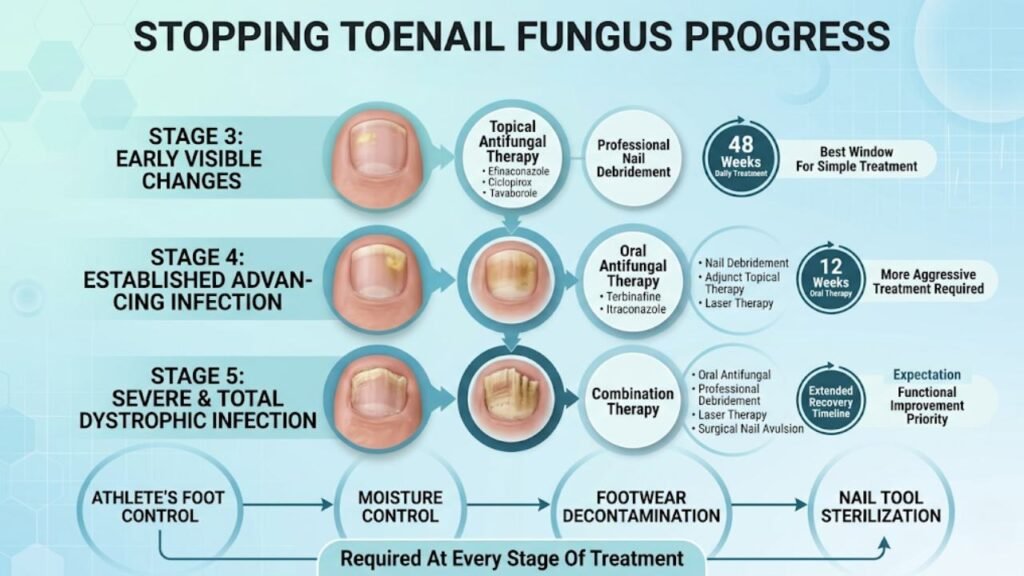
Early visible changes (Stage 3):
Topical antifungal therapy — efinaconazole, ciclopirox, or tavaborole — applied daily for 48 weeks. Combined with professional nail debridement. Best available window for simplest treatment pathway.
Established advancing infection (Stage 4):
Oral antifungal therapy — terbinafine as first-line for dermatophyte infection — for 12 weeks. Combined with nail debridement and topical antifungal as adjunct. Laser therapy as additional component when available.
Severe and total dystrophic infection (Stage 5):
Combination oral antifungal plus debridement plus laser therapy. Surgical nail avulsion for total dystrophic cases. Extended treatment timelines. Realistic expectation management regarding cosmetic outcomes.
At every stage: Treat concurrent athlete’s foot, maintain moisture control, decontaminate footwear, and sterilize nail tools.
Frequently Asked Questions About Toenail Fungus Progress
How fast does toenail fungus progress without any treatment?
Without treatment, toenail fungus progress typically moves through early visible changes within 2 to 5 months of exposure, reaches moderate infection within 6 to 12 months, and can reach severe or multi-nail involvement beyond 12 months. The exact timeline depends heavily on individual health factors and environmental exposure.
Can toenail fungus progress stop on its own?
Spontaneous resolution without treatment is rare in established infections. Most cases of clinically visible toenail fungus progress continue or worsen without antifungal intervention. Waiting for natural resolution is not a clinically sound strategy.
Does toenail fungus progress faster in people with diabetes?
Yes. Diabetes accelerates toenail fungus progress through elevated blood glucose that supports fungal growth, impaired circulation that reduces local immune response, and peripheral neuropathy that masks early pain signals that would otherwise prompt earlier evaluation.
How do I know if my toenail fungus is progressing?
Signs of active toenail fungus progress include: discoloration spreading from the tip toward the cuticle, the nail thickening compared to previous months, crumbling beginning at the edges, new nails showing changes, and the nail beginning to lift from the nail bed. Monthly comparison photos of affected nails can make progression visible.
Does treating athlete’s foot slow toenail fungus progress?
Significantly. Athlete’s foot is the primary ongoing source of fungal exposure for an infected nail. Treating tinea pedis removes this continuous reservoir and is one of the most effective single steps for slowing ongoing toenail fungus progress.
At what stage is toenail fungus hardest to treat?
Total dystrophic onychomycosis — Stage 5 — is the most treatment-resistant presentation. The infection is deeply embedded in nail structures including the matrix, often involves multiple nails, and requires combination treatment over extended periods. Toenail fungus progress caught at Stage 3 is dramatically easier and faster to address.
Summary
Toenail fungus progress is gradual, predictable, and almost always worsening rather than self-limiting without treatment. The five stages — spore exposure, silent colonization, early visible changes, established advancing infection, and severe dystrophic disease — describe a progression that unfolds over months and years but follows a consistent biological pattern.
The factors that most reliably accelerate toenail fungus progress are diabetes, immune suppression, concurrent athlete’s foot, nail trauma, sustained moisture exposure, and poor circulation. Patients with these factors need to monitor nail health more actively and act more promptly when early changes appear.
The most important clinical message about toenail fungus progress is that the treatment pathway is simpler, faster, and more reliably effective the earlier it begins. Stage 3 infection treated with topical antifungal therapy represents the ideal window. Stage 5 infection requiring combination oral therapy, debridement, laser, and potentially surgery represents what happens when that window closes without action.
If you have noticed nail changes that have persisted for more than a few weeks, professional evaluation now — rather than after further progress occurs — is the most practical investment you can make in your nail health.
Struggling to get an appointment?
We help patients in your area bypass clinic waitlists by instantly finding verified podiatry doctors who accept their insurance.